By Raje Rajasekaran, PhD candidate; Dr. Jutharat Attawet
As nurses, we are trained to recognise deterioration.
A falling blood pressure.
An increasing respiratory rate.
A change in level of consciousness.
These are warning signs that tell us a patient needs urgent intervention.
But what happens when the patient is our planet?
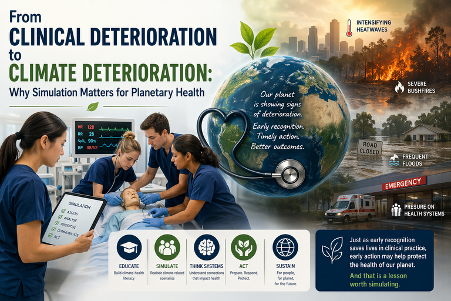
Around the world, we are witnessing signs that are becoming increasingly difficult to ignore. Heatwaves are intensifying, bushfires are becoming more severe, floods are occurring more frequently, and healthcare systems are experiencing growing pressure from climate-related events. Climate change is no longer a future problem. It is a present-day health issue that affects the communities we serve and the health systems in which we work. The Lancet Countdown has repeatedly highlighted climate change as one of the greatest threats to human health, with significant implications for healthcare systems globally (Romanello et al., 2024).
As a critical care nurse and nursing academic, I often reflect on the similarities between recognising clinical deterioration and recognising planetary deterioration. Both requires observation, assessment, critical thinking and timely action.
The challenge for nursing education is clear. How do we prepare future nurses for health emergencies that are increasingly shaped by climate change?
One answer may lie in simulation.
Simulation has long been used to prepare nursing students for complex clinical situations. Through simulated experiences, students learn to assess deteriorating patients, prioritise care, communicate effectively, and work a part of multidisciplinary teams. As simulation educators, we routinely teach students to recognise and respond to patient deterioration. The next challenge may be helping them understand how environmental deterioration influences human health and healthcare delivery.
What if we expanded these simulations to include planetary health challenges?
Imagine nursing students responding to a patient experiencing heat-related illness during an extreme heatwave.
Imaging a simulation involving evacuation during a bushfire emergency.
Imagine students managing multiple deteriorating patients during a climate-related disaster while facing limited resources and workforce shortages.
These are not hypothetical scenarios. They are becoming part of contemporary healthcare practice.
Simulation provides a safe environment where students can develop both clinical competence and climate-health literacy. It allows learners to explore the relationship between environmental change and human health while building the confidence required to respond to increasingly complex healthcare challenges. Emerging evidence suggests that simulation and scenario-based learning can enhance students’ understanding of sustainability challenges and support the development of decision-making skills needs to address complex real-world problems (Novaes et al., 2026).
Importantly, simulation can also help students develop system thinking. Planetary health reminds us that human health is inseparable from the health of the natural systems that sustain life. Through carefully designed simulation experiences, students can begin to understand the climate events affect hospitals, communities, public health systems supply chains, vulnerable populations, and healthcare resources.
This broader perspective aligns closely with the emerging planetary health competencies recommended for nursing education. Australian nursing leaders have highlighted, environmental stewardship, and the interconnected nature of human and planetary wellbeing (Levett-Jones et al., 2023). Fo many years, simulation has focused on preparing students for patient deterioration. Perhaps it is time to broaden our perspective and for simulation to also prepare students to recognise and respond to planetary deterioration.
Nurses have always been leaders in identifying risk, advocating for change, and protecting health. As climate change continues to reshape healthcare, simulation offers a powerful opportunity to prepare the next generation of nurses not only to care for patients, but also to contribute to a healthier and more sustainable future.
Just as early recognition saves lives in clinical practice, early action may help protect the health of our planet. And that is a lesson worth simulating.
Further Reading
Levett, T. (2023). Levett-Jones, T., Catling, C., Cheer, S., Fields, L., Foster, A., Maguire, J., McIntyre, E., Moroney, T., Pich, J., Pitt, V., Whiteing, N. & Lokmic-Tomkins, Z.,(2023). Planetary health, climate change and sustainable healthcare: Essential knowledge and skills for nursing students. University of.
Novaes, A. L. (2026). Enhancing sustainability education in higher education through simulation-based learning: integrating sustainable development goals. International Journal of Sustainability in Higher Education, 27(5), 1124-1141.
Romanello, M., Di Napoli, C., Green, C., Kennard, H., Lampard, P., Scamman, D., … & Costello, A. (2023). The 2023 report of the Lancet Countdown on health and climate change: the imperative for a health-centred response in a world facing irreversible harms. The Lancet, 402(10419), 2346-2394.