WARNING: We cannot be completely plastic-free this July.
That is the sad reality—and it is not a criticism of the powerful #PlasticFreeJulyTM movement. We should absolutely refuse unnecessary single-use plastics whenever we can.
But I want us to look beyond the shopping bag.
Although plastic pollution has become an ecological disaster of immense proportions, plastic was designed for products—not to become part of our food chain, the air we breathe or our bodies.
During my late teens and throughout my 20s, I worked in plastics manufacturing as part of my career as a chemical engineer. That experience taught me something the public conversation often overlooks:
A finished plastic product is rarely composed of polymer alone. Most conventional plastics are manufactured from petrochemical feedstocks derived from crude oil or natural gas, then combined with additives to provide properties such as flexibility, colour, durability, strength and heat resistance.
Plastics and other synthetic polymer materials also appear under many different names. Much like medicines can have generic and commercial names, these materials may be identified by their polymer family—such as polyethylene (PE), polypropylene (PP), polyvinyl chloride (PVC), polyethylene terephthalate (PET), polystyrene, expanded polystyrene (foam) polyurethane (PU), polycarbonate (PC), acrylic, nylon or elastane—or by familiar trade names. Examples include LYCRA® for elastane or spandex; Teflon™ for fluoropolymers, including PTFE; PERSPEX® for acrylic; LEXAN™ for polycarbonate; Mylar® for polyester film; and Kevlar® for aramid fibre.
PFAS —infamously known as “forever chemicals”—have rightly received growing attention, but they are only one part of a much larger chemical story. Depending on the material and its purpose, plastics may involve:
colour masterbatches and pigments; plasticisers; UV and heat stabilisers; antioxidants; flame retardants; lubricants and processing aids; antistatic agents; residual monomers; catalysts, impurities and reaction by-products; “non-intentionally added substances” formed during manufacturing, use or recycling
These substances are not present in every product, and they do not all carry the same risk. But the chemical complexity of plastics deserves far more public attention.
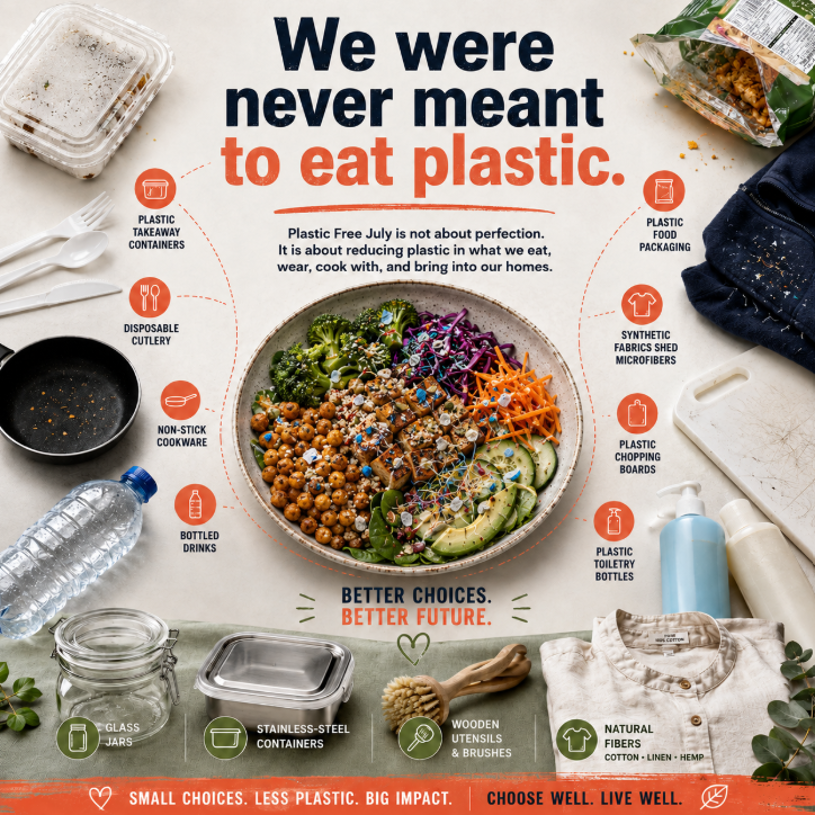
The issue extends far beyond what we drink through. Plastic can enter our daily lives through food containers, chopping boards, cooking utensils, takeaway cups, bottled drinks, synthetic clothing, bedding, carpets, cleaning cloths, kitchen sponges, personal-care packaging, paints and countless other products that surround us every day. As these materials are heated, scratched, washed, worn and broken down, they can release particles and chemicals into our homes and the wider environment.
We are now exposed to microplastics through the food and water we consume and the air we breathe. The full consequences for human health are still being investigated—but scientific uncertainty is not a reason to ignore preventable exposure (WHO, 2022).
This #PlasticFreeJuly, let us go further than refusing single-use plastic.
Start with the products exposed to heat, friction and repeated contact with food:
→ Avoid heating food in plastic.
→ Choose glass, stainless steel or ceramic for storage where practical.
→ Replace worn plastic chopping boards and cooking utensils with suitable wooden or stainless-steel alternatives.
→ Choose cotton, linen and hemp over synthetic fibres when possible.
→ Buy fewer products, reuse what you already own and replace items gradually rather than creating more waste.
→ Support refill and reuse systems.
→ Ask manufacturers what chemicals are in their products.
→ Demand stronger regulation, chemical transparency and producer responsibility.
Individual choices matter—but individuals cannot carry this burden alone.
Manufacturers, retailers and governments must eliminate unnecessary plastics, design safer products and take responsibility for the entire life cycle of what they produce.
Convenience is no longer a sufficient excuse. This is not about achieving perfection for one month.
It is about becoming aware of what we eat from, drink from, cook with, wear, wash and bring into our homes—and making better choices whenever we have the power to do so.
Small choices matter.
Systemic change matters even more.
We need both.
Organisations worth following and supporting include:
Plastic Free July
1 Million Women
Tangaroa Blue Foundation
Boomerang Alliance
Break Free From Plastic
Helpful resources include the WHO Plastics and Health Initiative, UNEP’s Chemicals in Plastics report, Food Standards Australia New Zealand’s information on microplastics in food, and the Plastic Free July resources library.
Plastic belongs in products designed for genuinely necessary purposes—not in our meals, our air or our bodies.
#PlasticPollution #Microplastics #PlanetaryHealth #PublicHealth #Sustainability #CircularEconomy #PlasticFreeJuly
Note: WHO (2022) recognises ingestion and inhalation as exposure routes while noting important uncertainty about long-term health effects. UNEP reports more than 13,000 plastic-associated chemicals, including thousands considered potentially concerning. Sources of microplastics include packaging, takeaway containers, synthetic clothing, paints and other degrading plastic products. Australian health guidance also recommends avoiding heating food in plastic and limiting plastic cooking utensils and chopping boards
References:
UNEP. (2023). Chemical in Plastics – A Technical Report. https://www.unep.org/resources/report/chemicals-plastics-technical-report
WHO. (2022). Dietary and inhalation exposure to nano- and microplastic particles and potential implications for human health. https://www.who.int/publications/i/item/9789240054608